Pranayama: how to practice the Yoga of Breath?
Conscious breathing, emotions, and global health
On the occasion of International Yoga Day, June 21, we explore Breath Yoga, a set of techniques that help us understand and optimize the most natural and fundamental activity of our life—the first one we do at birth: breathing. We will discover that Pranayama, Breath Yoga, offers significant benefits for our overall health, in terms of emotional regulation, psychological well-being, and physical health.
Breath and Global Health
The simple act of breathing profoundly impacts our overall health, both physical and psychological, because oxygenation plays a fundamental role in our physiology. Oxygen is essential for cellular respiration, and the breathing rhythm also affects the nervous system. For example, slow and deep breathing activates the parasympathetic nervous system, guiding the body toward rest and digestion. Shallow breathing, instead, activates the sympathetic system, putting us in a “fight or flight” alert mode.
Oral Breathing: Risks of Mouth Breathing
Sometimes, we may take the central role of breathing for granted because it is spontaneous and natural. However, paying attention to breathing and taking care of it is very important. For example, we may underestimate the impact of oral breathing, i.e., through the mouth, instead of the more natural nasal breathing, which filters, humidifies, and warms the air optimally.
Mouth breathing tends to increase respiratory frequency and produce excess mucus, favoring inflammation and respiratory infections. In children, it also causes incorrect tongue placement in the palate, leading to musculoskeletal development issues and potential orthodontic problems.
A Brazilian study on 370 children aged 3–9 years found that 55% of children breathe through their mouths. Conscious breathing education is therefore crucial from an early age to protect and enhance this vital function, influencing both physical health and emotional well-being.
Breath and Emotions
Breath and emotions are closely related and mutually influence each other in a bidirectional relationship. Breath, through oxygenation, provides us with vital energy, which varies depending on the situations we experience. These variations are reflected and communicated through emotions, guiding behavior and physiological activation.
Breathing is also naturally linked to smell, the phylogenetically oldest sense, which allows us to analyze situations and contexts instinctively, gathering valuable information about our environment. While breathing, we absorb energy but also “smell” the world, exploring life.
From Emotions to Breath
Our emotional state deeply affects breathing rhythm and pattern, reflecting our inner world. For example:
- fear or terror may cause breath-holding
- anger accelerates breathing to provide more energy for potential aggressive acts, with strong, short exhalations that release tension
- calmness is linked to slow, deep, diaphragmatic, and regular breathing
- sadness can manifest as irregular or shallow breathing with frequent sighs
- joy increases breathing rate rhythmically, with occasional deeper inhalations
- anxietyAnxiety is an emotional response characterized by feelings o... More causes rapid, shallow, and irregular chest-focused breathing
- during a panic attack, breath accelerates, further activating the sympathetic nervous system and increasing cortisolThe adrenal glands, small pyramid-shaped glands above the ki... More, creating a vicious cycle of stressFrom a clinical point of view, stress is a physiological and... More and discomfort
From Breath to Emotions
Breathing rhythm can also influence emotions. Slow, deep, diaphragmatic breathing, or box breathing, can calm emotions and reduce stress. Focusing on breath during meditation or mindfulness enhances awareness, self-regulation, and present-moment attention.
Scientific studies suggest that some breathing techniques promote emotional regulation via stimulation of the vagus nerve, crucial for the parasympathetic nervous system responsible for relaxation and energy conservation.
One way to start cultivating conscious breathing is through Pranayama, Breath Yoga.
What is Breath Yoga?
Pranayama is the fourth step to becoming a Yogi, i.e., a Yoga practitioner, and involves controlling the breath to consciously modulate energy and life force, called prana, to respond mindfully to both physical and psychological needs.
A complete yogic breath involves inhalation in three stages—abdomen, chest, then sternum—followed by an equal-duration exhalation, reversing the contraction sequence.
Different Techniques in Pranayama
There isn’t just one Breath Yoga practice; multiple techniques exist, ideally guided by a teacher, to support our overall health.
Nadi Shodhana: Alternate Nostril Breathing
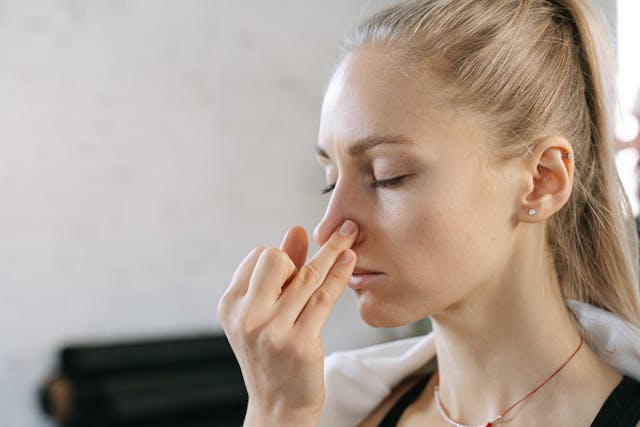
Among many Pranayama techniques, Nadi Shodhana uses alternate nostril breathing, leveraging the natural congestion-decongestion cycle of nostrils.
Steps:
- Close the right nostril with the thumb and inhale through the left nostril
- Close the left nostril with the ring finger and exhale through the right nostril
- Keep left nostril closed and inhale through the right nostril
- Close the right nostril and exhale through the left nostril
A 6-week Nadi Shodhana training reduces basal heart rate and blood pressure and modulates the parasympathetic nervous system, also reducing blood glucose levels.
Bhramari Pranayama: Bee Breath

Bhramari Pranayama, “Bee Breath,” involves making a humming sound while exhaling. Sit comfortably, close eyes, cover eyes with fingers, close ears with thumbs, inhale deeply, and exhale producing a continuous “mmmmmm” sound.
Bhramari improves psychological, cardiovascular, and pulmonary health, relieving hypertension and tinnitus, and enhancing attention, sleep quality, parasympathetic activity, while reducing stress, anxiety, depressionDepression is a disorder characterized by persistent sadness... More, sympathetic activity, and blood pressure.
Other Pranayama Techniques
Other practices include Bhastrika Pranayama, rapid breaths with rib movement, which reduces blood pressure and activates the parasympathetic nervous system, and Ujjayi Pranayama, expanding the chest during inhalation and producing a gentle throat friction sound, resembling ocean waves, reducing stress and modulating heart rate and blood pressure over time.
Benefits of Pranayama for Respiratory Health
A 2020 review in Journal of Drug Delivery and Therapeutics summarizes Pranayama benefits for respiratory health:
- strengthens diaphragm muscles
- increases lung air volume
- improves cellular oxygenation
- supports detoxification through exhalation
- reduces respiratory rate and anxiety
- facilitates breathing post-surgery or with pathologies
- supports treatment of asthma and bronchitis
Pranayama helps asthma patients by synchronizing breath, preventing hyperventilation, reducing stress, boosting immunity, and improving respiratory muscle strength and endurance. It also benefits COPD patients.
Yoga to Help Combat Allergies
Respiratory health requires special attention, as allergies and rhinitis are increasing due to pollution and climate change. These affect 10–30% of the population, with an overall incidence of 28%, according to Vincenzo Patella, President of the Italian Society of Allergy, Asthma, and Clinical Immunology.
Scientific studies show that yoga practices, including Pranayama and asanas, can relieve rhinitis symptoms. For instance, a 2-month Hatha Yoga program with 3 sessions per week reduced rhinitis symptoms, and a 2020 review showed decreased inflammatory cytokines linked to yoga practice.
Yoga as Mindful Movement
Yoga originates from Sanskrit yug, meaning “union.” It unites physical, cognitive, mental, and spiritual aspects of life, such as breath awareness in Pranayama or sleep in Yoga Nidra.
Yoga and mindful movement, like the Quadrato Motor Training program by Patrizio Paoletti, enhance creativity, spatial cognition, connectivity, and brain synchrony. These practices integrate body, emotions, and mind, linking inner and outer worlds, and support daily well-being through conscious action, emotion, and thought.
Be part of the change. Responsibly sharing content is an act of sustainability.
Let's train emotional intelligenceThe first definition of Emotional Intelligence as such was p... More: what emotion does this article arouse in you?