

Educate the inner world and be healthy consciously
On April 7, World Health Day, established by the World Health Organization, it is an opportunity to reflect on the progress made over the years and on the current mental health crisis, especially among adolescents. Fondazione Patrizio Paoletti, with over twenty years of neuro-psychopedagogical research and teaching, participates in raising awareness about mental health, promoting the importance of two fundamental questions: How are you? How are we? Its commitment demonstrates how focusing on the educational process constitutes the best strategy for prevention for mental well-being and global health.
Data: We are experiencing a global mental health crisis
According to available statistics, mental disorders have grown exponentially:
- 1 in 7 adolescents worldwide suffers from mental disorders
- Over 300 million people worldwide suffer from anxiety
- 300 million people worldwide suffer from depression (3.5 million in Italy)
- 80 million people suffer from bipolar disorder
- 726,000 people die by suicide each year.
The AXA Mind Health Report 2024 highlights the challenge of the link between mental health and workplace well-being, with 76% of Italian workers reporting at least one work-related disorder, including fatigue, loss of energy and interest, sleep disturbances, stress, and anxiety.
The economic impact of the mental health crisis is significant: it is estimated that the costs associated with depression, school dropout, and lower employment and productivity account for about 4% of global GDP.
Adolescent mental health
- 2 out of 10 adolescents in Italy live with a mental disorder
- psychiatric emergency admissions for anxiety and depression are steadily increasing (+25% at Ospedale Bambin Gesù in Rome)
- suicide is currently the second leading cause of death among young people.
On the occasion of World Mental Health Day, October 10, 2024, during the meeting “The Importance of Mental Well-being for Global Health”, Fondazione Patrizio Paoletti was invited to present its Adolescence Report and share operational and preventive strategies at the Chamber of Deputies. Among the main issues reported by adolescents are:
- The burden of school and social pressure (30%)
- Dependence on substances or technology (28%)
- Anxiety, depression, and low self-esteem (23%)
- Bullying and cyberbullying (19%).
Download the report: discover challenges and positive resources in the post-pandemic period
"*" indicates required fields
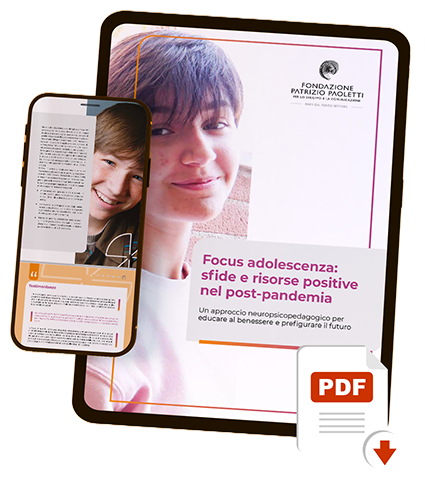
ADOLESCENCE FOCUS
Mental health: what are we talking about?
The World Health Organization defines mental health as a state of psychological well-being characterized by the ability to:
- cope with the stresses of life
- use one’s abilities productively
- learn and work effectively
- contribute to the community.
Consequently, mental health underlies our individual and collective capacity to make decisions, build relationships, and ultimately shape the world we live in.
Our mental health depends on the complex structure of the brain, which, while offering enormous potential, can also be vulnerable to dysfunctions. For this reason, it is essential to have proper education that allows us to manage this complexity.
What is the role of education in promoting mental well-being?
Not only does quality education provide better chances for overall good health, increasing life expectancy on average by 4 years, but it also provides solid foundations for the main protective factors of mental well-being:
- healthy habits
- supportive social connections
- access to good employment
- the ability to handle life’s challenges.
These factors can be enhanced through effective education that develops fundamental skills such as:
- self-awareness
- self-efficacy
- lifelong learning and problem-solving skills
- resilience.
Current crises highlight how unprepared we are to face rapid societal and global transformations. To build a sustainable future, it is not enough to find technological or economic solutions: it is necessary to educate the human being to manage their inner resources.
The holistic approach of Fondazione Patrizio Paoletti
The need for such a holistic and inclusive approach to child and adolescent development – the article argues – is increasingly evident to promote long-term health and well-being. The concepts outlined in the publication aim to respond to the need to transcend disciplinary boundaries and establish synergistic connections between multiple research areas that support holistic development, global health, and life-long well-being.
The publication proposes a conceptual framework addressing the integration of physical, cognitive, psychological, social, and emotional domains of child and adolescent development, considering:
- the critical nature of a systemic relational approach to human development
- a contemporary perspective on the links between cognitive, social, emotional, psychological, and physical development
- the critical importance of holistic development affecting long-term mental health trajectories starting in early childhood
- a pragmatic approach to promoting holistic development using a pedagogical framework called MTSS (multi-tiered system of support).
This approach to education as a tool for protecting and developing mental well-being, according to Pedagogy for the Third Millennium, requires a crucial factor to be fully effective: the ability to envision a sustainable future.
Pedagogy for the Third Millennium
This method considers the human being as a whole, integrating four fundamental dimensions:
- physical (importance of movement for cognition)
- emotional (development of emotional intelligence)
- rational (effective use of cognitive resources)
- aspirational (orientation towards personal values and goals).
These different factors must be considered to develop lifestyle habits that protect mental well-being and strengthen resilience. All parts of the self are deeply interconnected and must be considered in their mutual interactions.
From childhood, individuals need to learn to relate to the functioning of their own body, discovering, for example, the importance of movement for cognitive processes. They also need to understand the emotional dimension with its intelligence and the effective use of cognitive resources.
Finally, the ability to envision one’s future, based on personal values, is a precious orientation factor for life.
What prevents us from looking to the future with hope?
Eco-Anxiety, a term used in research for the widespread feeling of frustration among younger generations in the face of the climate crisis, is well summarized by this quote: “When the future of all living beings is in danger, it is hard not to feel depressed.” These are the words of a participant in a survey of 10,000 minors in 10 countries. Over 50% of participants reported feelings of sadness, anxiety, anger, helplessness, and guilt regarding the ongoing climate crisis.
73% of young people aged 16–24 in the UK reported that the climate crisis negatively affects their mental health, consistent with trends expressed by adolescents worldwide.
Further research conducted immediately after the Covid19 pandemic shows that difficulty envisioning the future correlates with a decrease in life meaning, especially among university students, young people on the threshold of adulthood.
A post-Covid19 study of 3,100 university students showed that actively seeking a vision for the future correlates with attributing greater meaning to one’s life, enriching every experience.
Conversely, lack of a vision for the future has been observed to correlate with violent radicalization phenomena.
Envisioning the Future to keep the mind vital
Learning to envision the future is the revitalizing factor for all psychological well-being skills, allowing us not only to feel well but also to move toward an even better state. Mental well-being today cannot be considered static; it is dynamic, adaptive, and improving. Acquiring this exceptional mind skill of conscious envisioning can make a difference for the lives of both young and older individuals.
Developing the capacity to envision the future is part of Life Skills education, psychosocial abilities in personal, social, interpersonal, cognitive, and affective areas, which the WHO has confirmed as key techniques for promoting Health Education in schools.
The importance of socio-affective education lies in its ability not to focus on a specific prevention topic – reads the ISS statement – but on a methodology aimed at enhancing skills in dialogue, communication, listening, and effective relationships in growing individuals. Socio-affective education includes strategies and activities that can be introduced very early in schools.
Fondazione Patrizio Paoletti has been engaged for years in Life Skills training programs, integrated into the curriculum of its school AIS – Assisi International School, applying Montessori Method and Pedagogy for the Third Millennium. Life Skills are also developed in the Prefigurare il Futuro program, initially designed to support populations affected by the 2016 central Italy earthquake, which has had such a positive impact that it has expanded to secondary schools throughout Italy, spreading methods and strategies for emotional regulation and self-awareness.
Fondazione Patrizio Paoletti is also active in promoting these skills at the European level through projects such as EQ Students – Emotional Intelligence, the mind that feels, aiming to increase emotional intelligence awareness in schools and the labor market.
Adolescence news, Increase your well-being, News from our research, News on adolescence, Pedagogy for the Third Millennium, Prevenzione e benessere mentale
