The Multitasking Mom
The Importance of Rest and Sharing
Multitasking describes the ability to follow multiple activities simultaneously: a characteristic that is common among mothers. It is a strategy that responds to the need for speed and the complexity of our lives. Multitasking allows us to manage different responsibilities at the same time, sometimes even competing with each other. Maternal and female enthusiasm for doing, between family and work, can, however, lead to anxietyAnxiety is an emotional response characterized by feelings o... More and stressFrom a clinical point of view, stress is a physiological and... More. When multitasking becomes necessary, rest is fundamental. Research emphasizes sharing, to make the juggling of time a more positive experience.
Multitasking: from computing to human life
The term “multitasking” originated in computer language, to indicate a software’s ability to execute multiple programs or tasks simultaneously. The program can switch from process 1 to process 2 according to the operating system’s instructions, which optimizes time and performance. The term has passed from computing to humans, describing moments when our attention performs multiple tasks at the same time.
This ability is among the main executive functionsThe term 'executive functions' refers to a set of mental pro... More: cognitive processes that coordinate information and actions to achieve a goal. Multitasking occurs, for example, while driving and simultaneously talking to a passenger next to us. Part of our brain is engaged in monitoring the road, while another part follows the conversation. Something similar happens when we cook dinner: we sauté something in a pan while monitoring the oven where the bread is rising.
The cost of multitasking
Our brain is wired for light multitasking, thanks to divided attention. Moreover, dopamineA neurotransmitter found in the brain and central nervous sy... More makes us feel satisfied when we successfully complete a task. Yet, switching attention from one task to another has a cost. Already in the 1990s, a study measured this transition. Data showed that performing two tasks in multitasking takes more time than completing them separately.
A 2001 study demonstrated that the time lost in switching increases with task difficulty. In short, multitasking is not always synonymous with efficiency. It also risks becoming truly excessive in a faster-paced daily life. Doing too many things simultaneously can have harmful effects on psychological well-being: it can make us feel more anxious, stressed, and even depressed.
The multitasking mother and woman
According to Israeli research, mothers spend ten more hours per week multitasking than fathers. This is mainly due to household chores and childcare responsibilities. For mothers, however, multitasking is more strongly associated with an increase in negative emotions, stress, psychological discomfortThroughout life, each of us goes through complex phases, in ... More, and work-family conflict.
Yet, British research suggests that women tend to be more effective than men at multitasking. Analysis indicates that women seem to organize their time better under pressure. Mothers, therefore, may be more effective at multitasking but also suffer more from it. With remote work, the challenge of balancing family and work responsibilities has often become more pressing for both men and women.
Rest
When tasks are too many or time pressure is excessive, our brain overloads, just like a machine. In this case, recovery and rest time is essential to recover from the effort and recharge. A good copingCoping is the ability to face and manage stress, challenges,... More strategy for managing stress and life’s challenges must necessarily include rest. A short break, from 3 to 10 minutes, if used for deep and restorative relaxation, helps restore and renew attention. Even a micro-break, under 3 minutes, is valuable to reduce cognitive overload.
Sleep, including a nap, also helps memoryMemory is a fundamental cognitive function that consists in ... More, stabilizing memory traces and aiding problem-solving. Excessive rest, however, can be counterproductive if it causes delays, which can also be a source of stress. Dynamically organizing and reorganizing priorities is therefore an art that requires refined sensitivity. It also means learningThe term learning—with the synonyms to learn, assimilate, ... More to listen to ourselves to maintain a healthy and constructive rhythm.
To improve awareness, Fondazione Patrizio Paoletti has dedicated to mothers the free Edukit: 10 Exercises for the Mindful Mother. By becoming more aware, we can organize a proper break. Leisure browsing on social media may allow us to disconnect, but probably not to truly rest and recharge. A Stanford University study suggests that when multitasking transfers to media and becomes chronic, our memory capacity declines. It also increases impulsivity and distractibility, preventing real regeneration.
It is much better to take a walk in nature, with profound benefits for mind and body. Alternatively, we can dedicate time to meditationThere are many ways to define meditation, but perhaps the si... More, perhaps in its moving forms, such as Quadrato Motor Training.
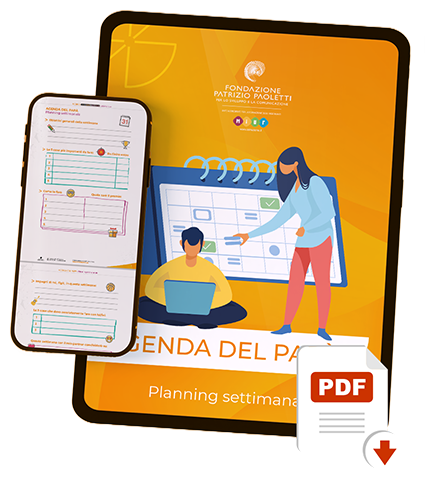
Download the weekly planner designed to help you be the father you want to be, with space for ideas, appointments, and educational goals.
"*" indicates required fields
DAD'S AGENDA
Sharing and planning
When juggling multiple fronts becomes necessary, human relationships can help. The Israeli research on maternal multitasking found that if work is shared with a spouse or children, the experience is perceived positively. The study highlights the important role of sharing and relationships, even in fulfilling our various duties.
Working together helps us divide tasks, making us feel relieved from multiple, heavy burdens and establishing a priority scale. Often, not everything is truly urgent as it may seem. Scheduling, planning, postponing, and sometimes delegating is essential to avoid living in chronic urgency. A spouse’s presence can lighten household multitasking and aid in planning.
For this purpose, Fondazione Patrizio Paoletti also provides the Dad’s Agenda for free, to remind us of deadlines and, above all, priorities. Among these, the most important is global healthIn the vast and multifaceted landscape of global health, the... More, which also includes satisfaction and happinessHappiness represents an emotional state characterized by pos... More, preferably shared.
Be part of the change. Responsibly sharing content is an act of sustainability.
Let's train emotional intelligenceThe first definition of Emotional Intelligence as such was p... More: what emotion does this article arouse in you?